Breast Lift Scars: What They Look Like, Where They Are, and How They Fade
Undergoing a breast lift (mastopexy) is a major step toward improving breast shape, position, and overall confidence. However, like any surgical procedure, it involves incisions and therefore scars.
Understanding what breast lift scars look like, where they are placed, and how they change over time is essential for setting realistic expectations and supporting proper healing.
Many patients worry about scars before surgery. The good news is that while scars are permanent, they usually fade significantly and become much less noticeable over time when healing is managed properly.
This guide explains everything you need to know about breast lift scars, including types, healing stages, and how to care for them effectively.
What Do Breast Lift Scars Look Like?
Breast lift scars fade gradually and become less visible over time, especially when patients follow the instructions and manage healing properly.
Early Appearance of Scars
Right after surgery, breast lift scars are usually:
- Red or pink
- Slightly raised
- Firm to the touch
- More visible than expected
This early appearance can be surprising, especially for patients expecting immediate aesthetic results. However, this is a normal part of the healing process.
How Do Scars Change Over Time?
As healing progresses, breast lift scars typically:
- Fade from red to lighter pink or skin tone
- Flatten and soften
- Become less noticeable
- Blend more naturally with surrounding skin
Scars often look more obvious before they start to improve. This does not mean something is wrong, it is just part of normal scar maturation.
Where Are Breast Lift Scars Located?
The location of scars depends on the breast lift technique used. Each technique is chosen based on how much lift is needed and the patient’s anatomy.
1. Around the Areola (Periareolar Scar)
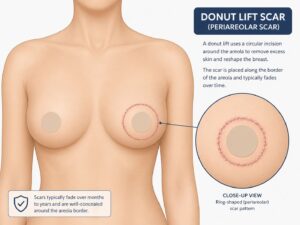
This scar runs along the edge of the areola. It looks like a circular line around the nipple area, often blending well with the natural colour transition. This is used for mild lifting and minimal sagging.
2. Vertical Scar (Lollipop Scar)
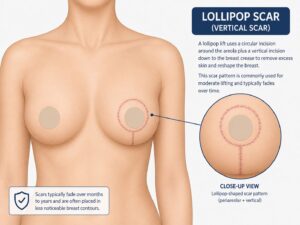
This technique includes a circle around the areola and a vertical line from the areola down to the breast crease looking like a “lollipop” shape. It’s usually used for moderate lifting and reshaping.
3. Anchor Scar (Inverted T)
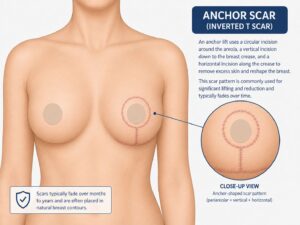
The anchor scar, also known as the Inverted T, is located around the areola with a vertical line downward and a horizontal line along the breast crease. It’s used for significant sagging or major reshaping.
Why Does Scar Placement Matter?
Surgeons place incisions strategically to:
- Allow proper reshaping and lifting
- Minimize tension on the skin
- Help scars sit in less visible areas
- Improve long-term healing
Even though scars are part of the procedure, their placement is planned carefully to balance visibility and surgical results.
Breast Lift Scars Healing Timeline
Understanding the scar healing timeline helps reduce anxiety and avoid unrealistic expectations.
Weeks 1–2: Early Healing Phase
- Incisions are fresh
- Scars appear red, swollen, and slightly raised
- Dressings or tapes may still be in place
Weeks 3–6: Active Healing Phase
- Scars begin to close and stabilize
- Redness may increase before improving
- Itching or tightness may occur
At this stage scars may look worse before they get better. This is part of the natural healing process.
Months 2–6: Maturation Phase Begins
- Scars start to flatten
- Colour gradually fades
- Texture becomes softer
- They become less prominent but are still visible.
6–12 Months: Long-Term Fading
- Scars continue to lighten
- Blend more with surrounding skin
- Become smoother and less raised
Final scar appearance becomes clearer, though minor changes may continue beyond one year.
How to Care for Breast Lift Scars?
Proper scar care plays a major role in how scars look in long term.
- Follow all wound care instructions
- Keep incisions clean and dry
- Wear the recommended support bra
- Protect scars from sun exposure
- Use scar treatments if recommended
- Attend follow-up appointments
What to Avoid?
- Picking or scratching scabs
- Using unapproved creams early
- Exposing scars to direct sunlight
- Wearing tight or irritating bras too soon
Following your surgeon’s instructions is the most important factor in achieving better scar outcomes.
What If a Scar Looks Abnormal?
While most scars heal normally, some changes may require attention.
Signs to Watch For:
- Increasing redness or swelling
- Thick, raised scars (possible hypertrophic scars)
- Spreading scars beyond incision lines (possible keloids)
- Pain or unusual sensitivity
- Delayed healing or wound opening
What to Do:
- Do not try to treat it yourself
- Take a photo for reference
- Contact your surgeon for advice
Early management is always easier than delayed treatment.
Common Concerns About Breast Lift Scars
Will Breast Lift Scars Be Permanent?
Yes, scars are permanent, but they usually fade significantly over time and become much less noticeable.
Do Breast Lift Scars Fully Disappear?
No, scars do not disappear completely. However, with proper healing and care, they often become faint and blend with the skin.
Are Breast Lift Scars Visible in Clothing?
Most scars are placed in areas that are covered by bras, bikinis, and clothing. In many cases, they are not visible in normal daily wear.
Can You Improve the Appearance of Scars?
Yes, scar appearance can improve with proper care, time, and in some cases, treatments such as silicone products or medical scar therapies recommended by your surgeon.
How to Support Better Scar Healing?
Patients who follow simple habits often achieve better scar outcomes.
- Avoid smoking
- Maintain stable weight
- Follow recovery instructions closely
- Avoid early tension on incisions
- Keep follow-up appointments
Healing is not only about the surgery itself. It is also about what happens afterward.
Why Choosing the Right Surgeon Matters for Scars?
Scar quality depends not only on healing, but also on surgical technique.
A skilled surgeon:
- Places incisions carefully
- Minimizes tension on the skin
- Chooses the right technique for your anatomy
- Provides clear aftercare instructions
Poor planning or technique can increase scar visibility, while good surgical judgment helps optimize long-term results.
Key Takeaway
Breast lift scars are a normal and expected part of the procedure, but they change significantly over time. What looks noticeable in the early weeks often becomes much softer, lighter, and less visible in the months that follow.
Understanding where scars are placed, how they heal, and how to care for them helps you approach surgery with realistic expectations and less anxiety.
Worried About Breast Lift Scars?
Scars are a normal part of mastopexy, but the right technique, careful incision placement, and proper aftercare can make a big difference in how they heal and fade.
Get a personalized scar and breast lift assessment based on your anatomy, skin quality, and goals.
Check Your Breast Lift Scar Plan
Free assessment · Realistic expectations · Clear aftercare guidance